
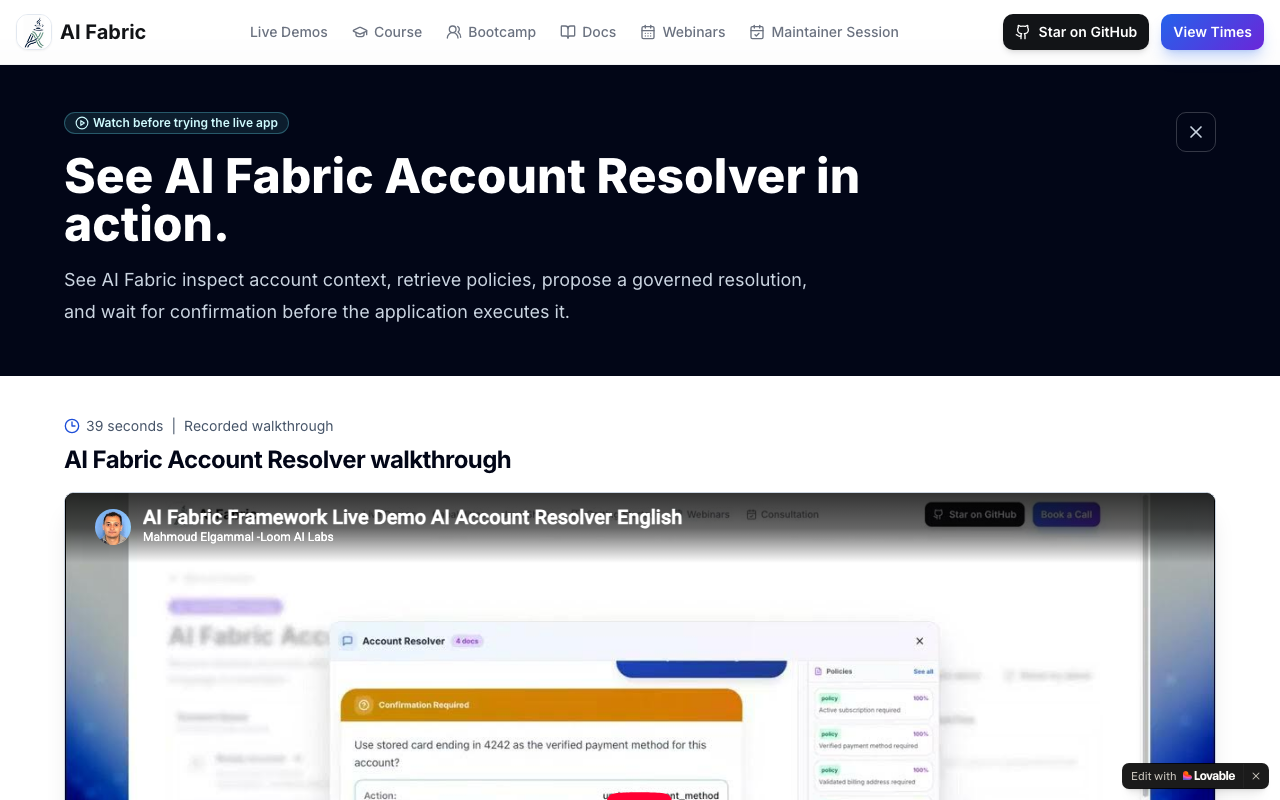
Question
Hypothesis
Can confirmation stay useful when user-provided parameters are imperfect, while trusted resource identifiers remain protected?
What this demonstrates
- Validation warnings can be shown without silently discarding user-confirmed values.
- Trusted resource identifiers remain blocking when provenance is not established.
- The final operation is performed by application code.
What this does not demonstrate
- Real billing-provider integration
- Unattended financial operations
- Suitability for high-risk account changes
Architecture and data flow
- 01 Synthetic source data
- 02 Host application policy
- 03 AI Fabric capability
- 04 Observable UI result
Guided steps
- 01
Open a synthetic account scenario.
- 02
Ask for a supported account change in natural language.
- 03
Review validation evidence and confirm the proposed operation.
Observable evidence
The running application and its health surface are the public evidence for this experiment. The source repository exposes the implementation path behind the visible result.
Security and data boundary
The application owns subscription state, validation policy, trusted identifiers and execution. The model proposes structured intent; it does not bypass those checks.
All account, subscription and billing records are synthetic.
Known limitations
- The supported action catalog is deliberately narrow.
- No external payment provider is contacted.