
Question
Hypothesis
Can one application make retrieval evidence and conversation controls visible without exposing its domain rules to the model or browser component?
What this demonstrates
- The health surface reports AI Fabric 0.4.0 and enabled chat, retrieval and data-sync capabilities.
- The application exposes index readiness and retrieval proof instead of hiding an empty index.
- Conversation behavior remains backend-owned.
What this does not demonstrate
- Customer adoption or production certification
- Real merchant catalog accuracy
- Autonomous purchasing or payment execution
Architecture and data flow
- 01 Synthetic source data
- 02 Host application policy
- 03 AI Fabric capability
- 04 Observable UI result
Guided steps
- 01
Open the live application and seed its synthetic catalog when prompted.
- 02
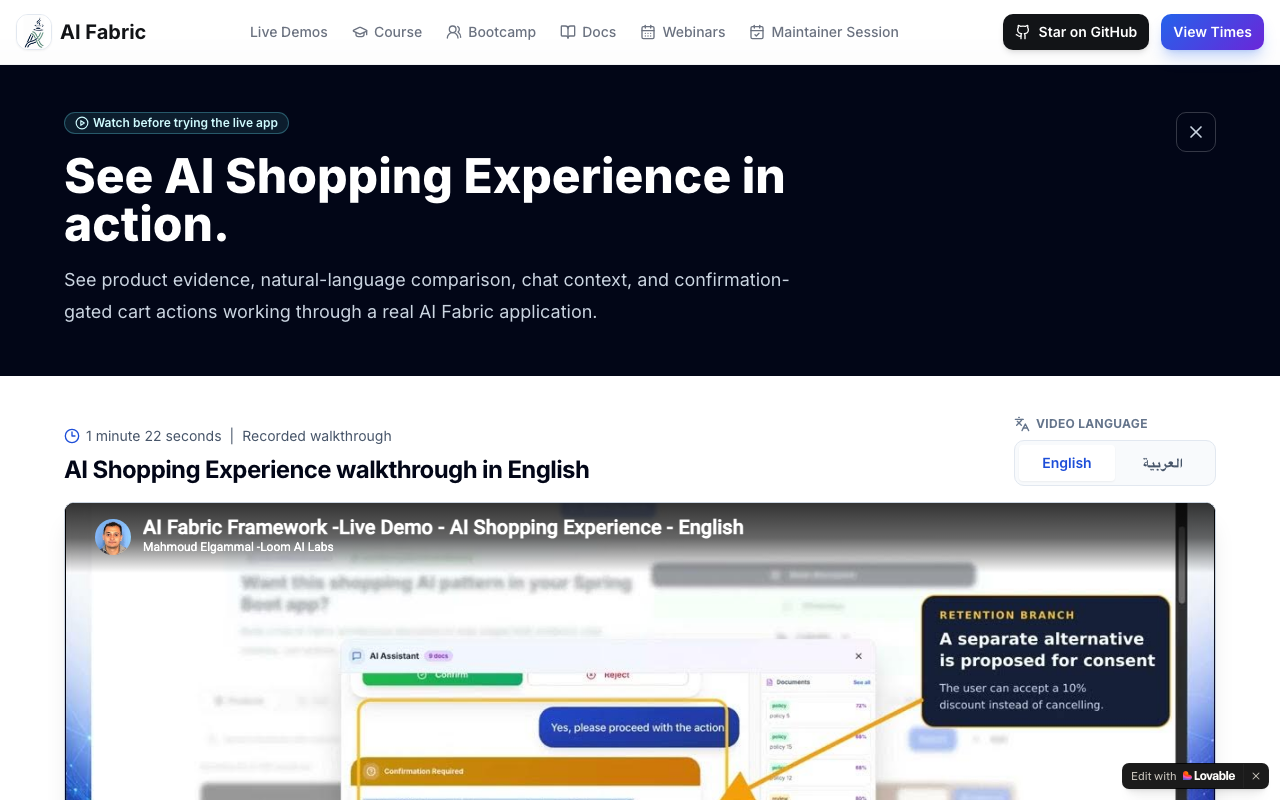
Ask a product question that requires catalog evidence.
- 03
Inspect the returned evidence and continue the same conversation.
Observable evidence
The running application and its health surface are the public evidence for this experiment. The source repository exposes the implementation path behind the visible result.
Security and data boundary
The demo application owns catalog records, session behavior and customer-facing decisions. AI Fabric supplies orchestration contracts; Chat UI presents the result.
The experiment uses synthetic catalog and conversation data.
Known limitations
- The catalog is intentionally small and synthetic.
- The live environment is an engineering demo, not a service-level commitment.