Abstract
Research question
How can an application make entity-to-index consistency visible and recoverable as source records change?
Context
Grounded answers become unreliable when application records and retrieval indexes drift. A successful API response alone does not establish that a newly indexed entity can be found, or that a deleted entity has disappeared.
Proposed approach
- Model create, update and delete as explicit entity lifecycle operations.
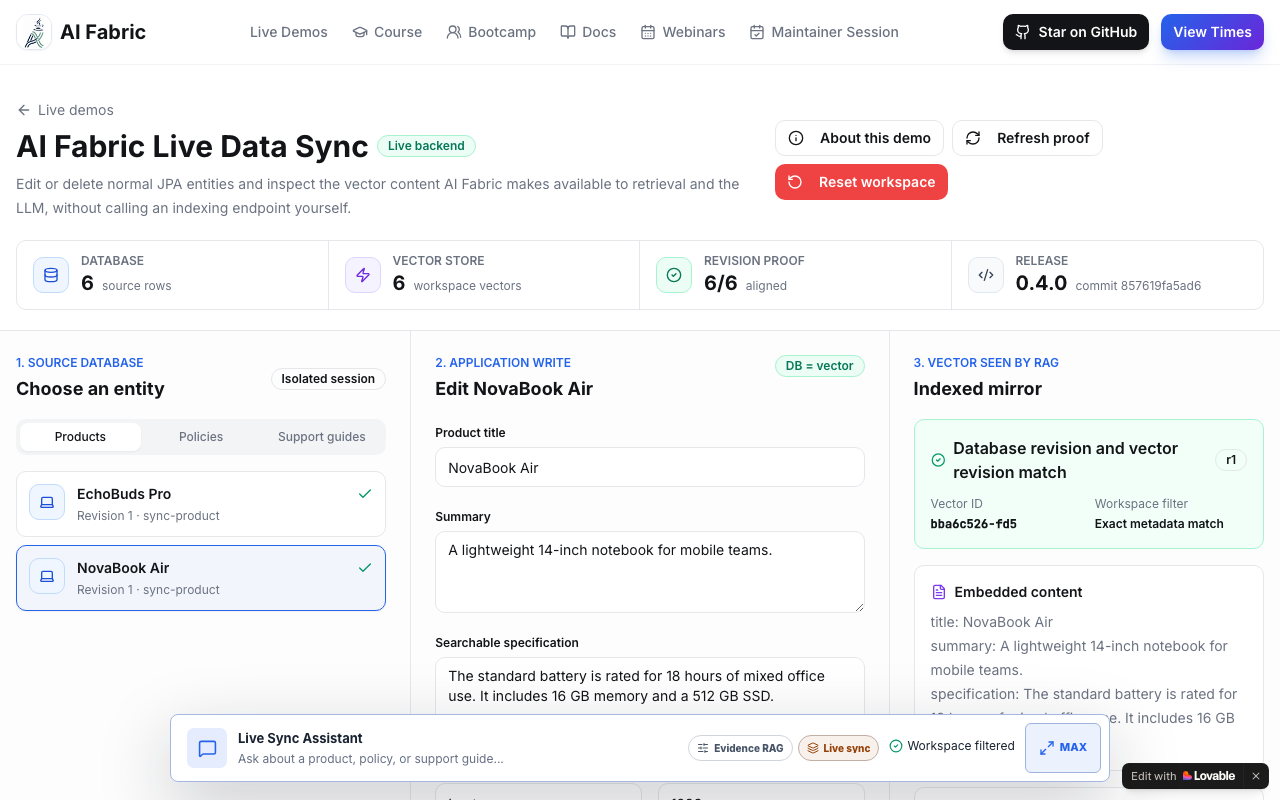
- Expose source counts, queue state, vector counts and a known-entity retrieval probe.
- Keep the application database authoritative and make replay safe.
Implementation
- AI Fabric 0.4.0 entity indexing contracts
- A Spring Boot reference application with persistent source records
- A live readiness surface covering source, queue and retrieval proof
Observations
- 01
A vector count is useful but insufficient; a known-entity probe reveals routing and metadata failures.
- 02
Delete semantics need the same operational evidence as create and update.
- 03
A visible empty stage prevents a demo from implying retrieval readiness before data exists.
Limitations
This work reports an implementation-linked investigation. It is not a
peer-reviewed paper, certification or customer case study.
- The live proof uses a single application instance and a compact synthetic dataset.
- The work does not publish throughput or durability benchmarks.
Reproduce or inspect
Revision note and next questions
Last revised 2026-07-25 against AI Fabric 0.4.0 and the linked public artifacts.
- How should repair plans be generated across distributed indexing workers?
- Which readiness evidence belongs in framework APIs versus platform operations?