Loom AI Labs

Products / AI Fabric Framework Open source · Early release

Build intelligent Java applications without surrendering application control.

Connect live application data, evidence-grounded retrieval and governed actions to Spring Boot while your application retains authority over identity, authorization, validation, persistence and execution.

  • Java
  • Spring Boot
  • Spring AI
  • Provider-neutral
  • Apache 2.0
@AICapable(entityType = "product")
class Product { ... }

@AIProcess(operation = AIProcessOperation.UPDATE)
Product save(Product product) { ... }

Application-owned

Identity & Policy Users, tenants, roles, capabilities
Domain Services Validation, business rules, workflows
Application DB Relational DB, source of truth

AI Fabric enablement

Orchestration Coordinate retrieval, actions and policy
Live Evidence Keep approved evidence aligned with app data
Governed Actions Propose, verify and act within policy

Providers

Models LLMs and inference
Embeddings Embedding models
Vector Stores Vector databases and search
Entity changeApp data updated
@AIProcessHook triggered
Evidence updatedRetrieval store aligned
Action proposedIntent generated
Policy checkRules evaluated
ConfirmApproved to proceed
Application serviceExecution in app

The application remains the authority

An enablement layer built around application authority

Annotation-driven integration

Declare searchable entities, context and lifecycle hooks using familiar Java annotations.

Live data synchronization

Keep approved retrieval evidence aligned with application changes.

Governed retrieval & actions

Ground responses in evidence and require policy checks or confirmation before execution.

Provider flexibility

Integrate models and vector stores behind richer framework contracts.

  1. Application data, identity & policy Source of truth
  2. AI Fabric orchestration & evidence flow Enablement layer
  3. Models & vector stores Pluggable providers

Public architecture

Application authority, made inspectable.

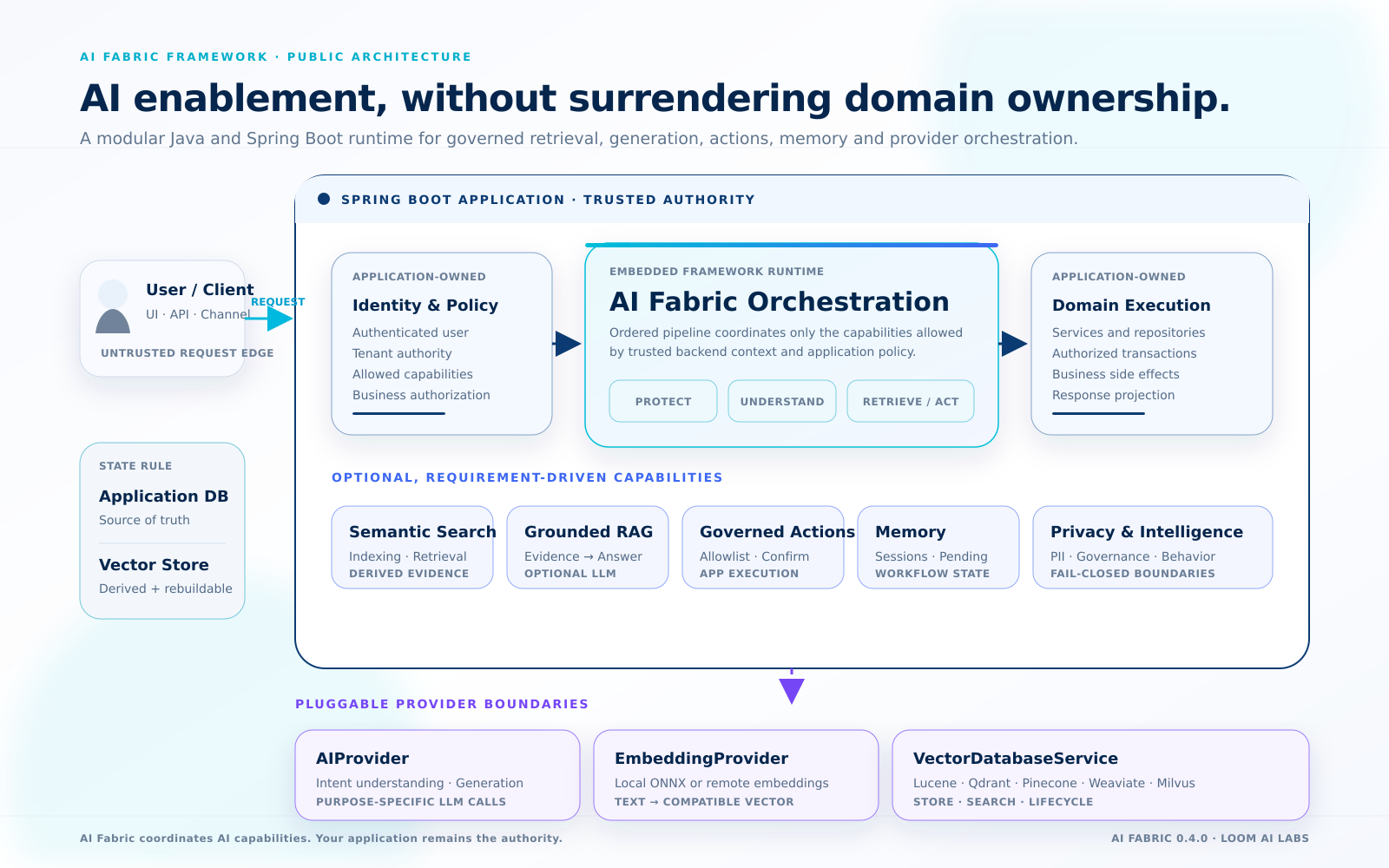
AI Fabric embeds inside the Spring Boot application and coordinates only the optional capabilities that the application enables.
Open architecture
AI Fabric architecture showing the Spring Boot application as trusted authority, embedded orchestration, optional capabilities, and pluggable model, embedding, and vector database providers
Application data and authorization stay authoritative; vector state is derived and provider boundaries remain replaceable.

Ordered request pipeline

Every governed request follows an explicit contract.

Protection, context resolution, intent handling, result normalization and recording happen in a stable order, with optional steps activated only when their modules are present.
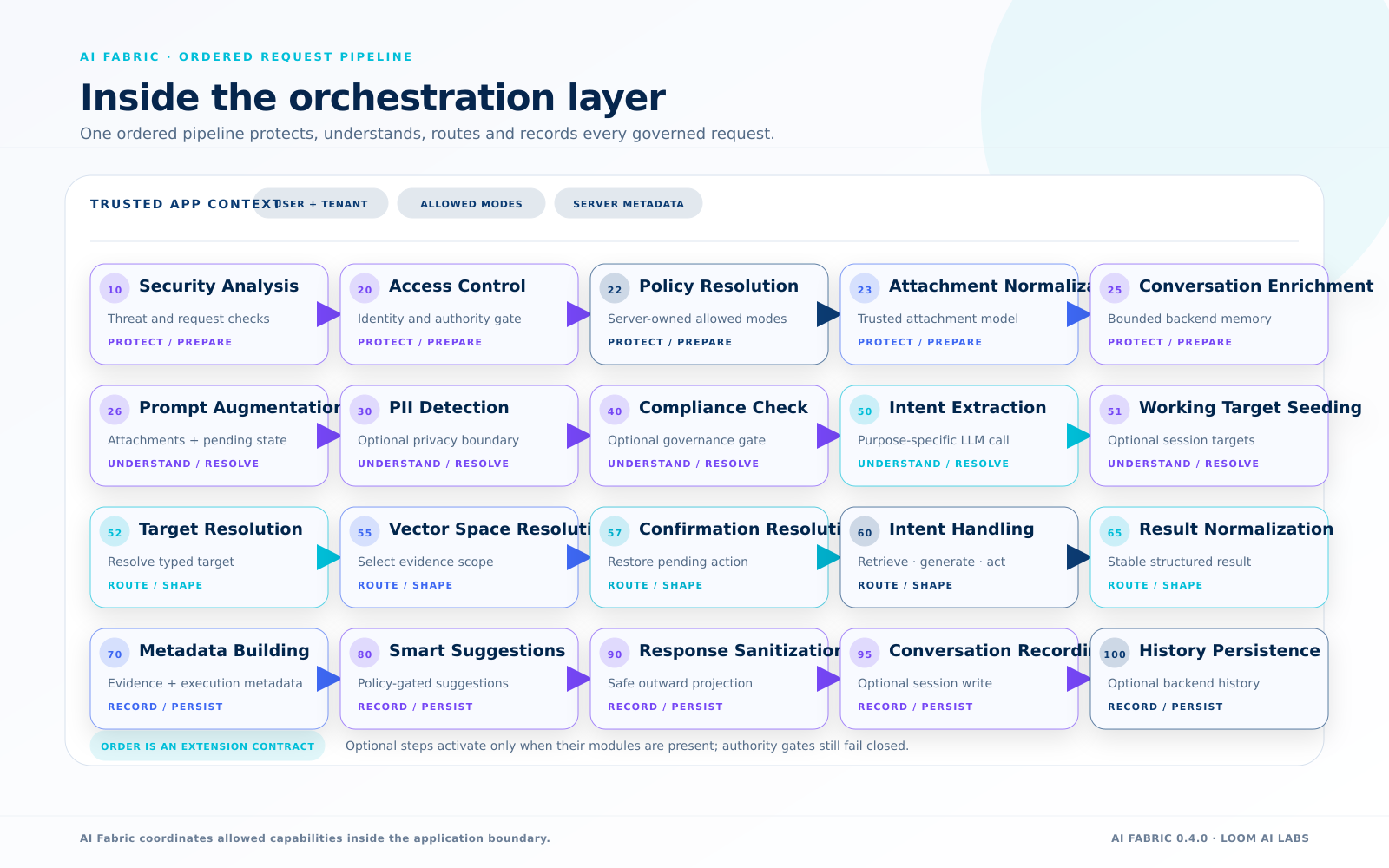
Open pipeline
Ordered AI Fabric orchestration pipeline from security and access control through intent handling, result normalization, response sanitization, and optional conversation persistence
The order is an extension contract: authority gates fail closed while optional intelligence and persistence stages remain modular.

The problem

Useful AI needs software boundaries, not only prompts.

Useful AI features need more than a model call. They need application context, current data, observable evidence and action boundaries that survive real software lifecycle changes.

The product value

A reusable layer with an explicit host contract.

AI Fabric makes those boundaries explicit and reusable while staying close to Spring Boot and Spring AI. Teams can adopt the capabilities they need without moving their domain into a second application platform.

Ownership boundary

Product responsibility stops before application authority.

Framework owns

  • Orchestration contracts and pipeline behavior
  • Retrieval, evidence and structured result contracts
  • Action proposals, confirmation state and execution hand-off
  • Provider-neutral configuration and extension points

Host application owns

  • User identity, sessions and tenant authorization
  • Business rules, resource ownership and source-of-truth data
  • Action implementation and final permission checks
  • Product UI, customer promises and operational policy

Quick start

Begin with one application-owned path.

Start from the public documentation, wire one bounded scenario and keep authorization and source data in the host.

Developer guide
<dependencyManagement>
  <dependency>
    <groupId>io.github.loom-ai-labs</groupId>
    <artifactId>ai-fabric-bom</artifactId>
    <version>0.4.0</version>
    <type>pom</type>
    <scope>import</scope>
  </dependency>
</dependencyManagement>

Live proof

See Framework in bounded applications.

live Adaptive experience

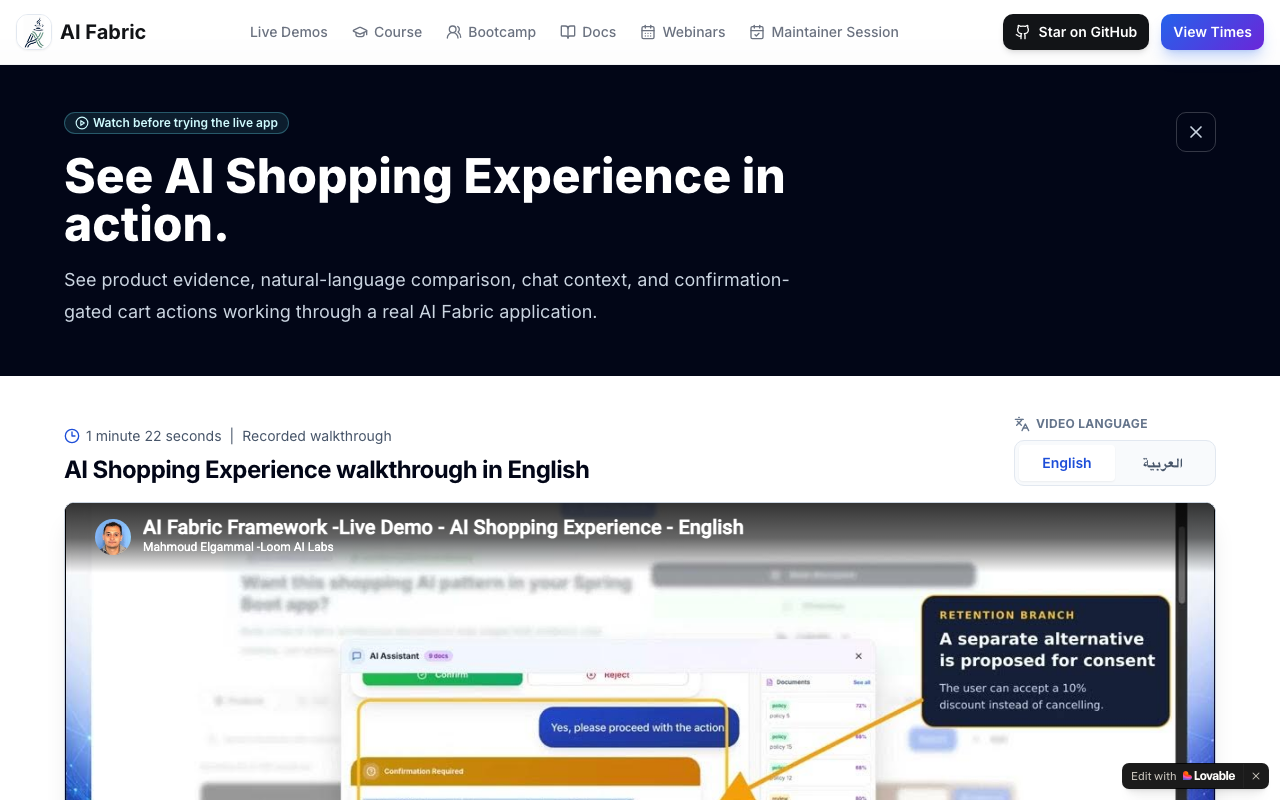
AI Shopping Experience

A shopper explores synthetic products, asks grounded questions and inspects the evidence behind the response.

  • RAG
  • Evidence
  • Chat sessions
  • Data sync

The health surface reports AI Fabric 0.4.0 and enabled chat, retrieval and data-sync capabilities.

live Governed actions

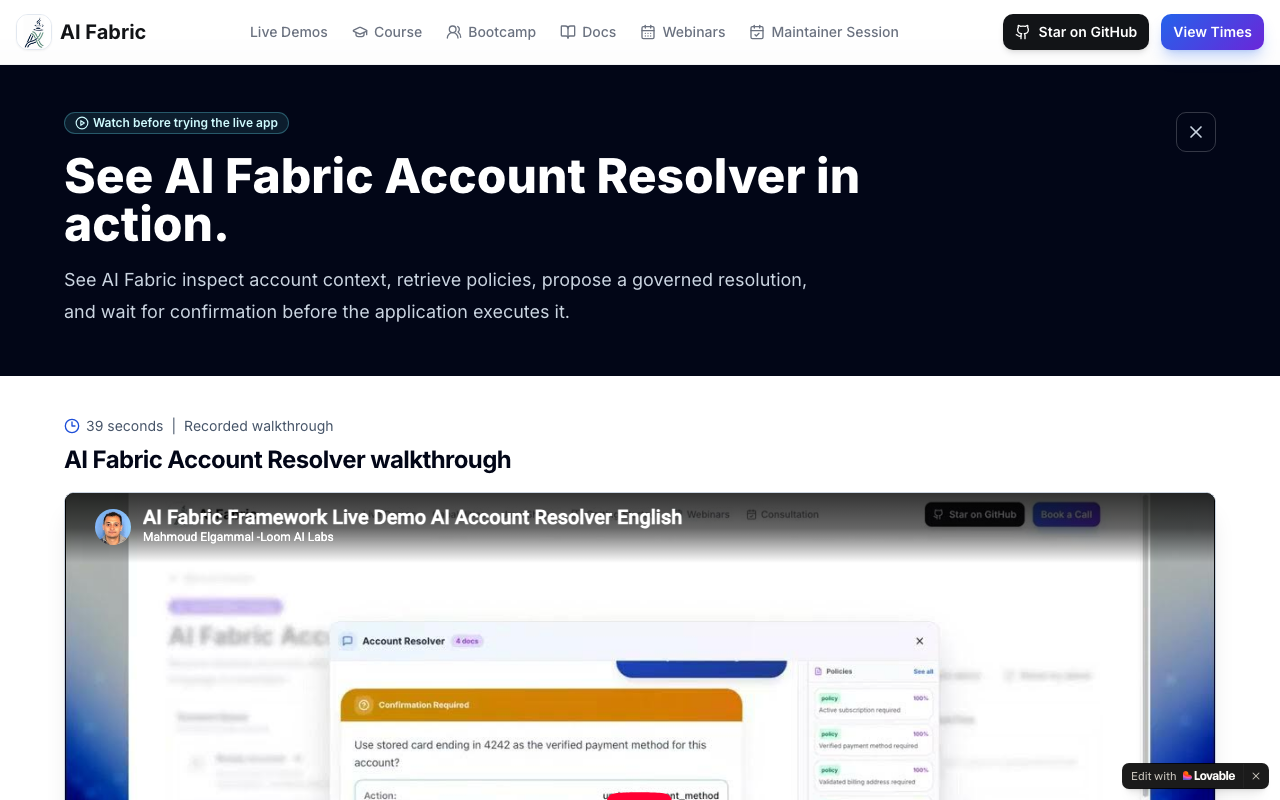
Account Resolver

A user asks for account help, reviews the proposed operation and confirms only after the application exposes validation evidence.

  • Actions
  • Validation
  • Confirmation
  • Audit

Validation warnings can be shown without silently discarding user-confirmed values.

live Adaptive experience

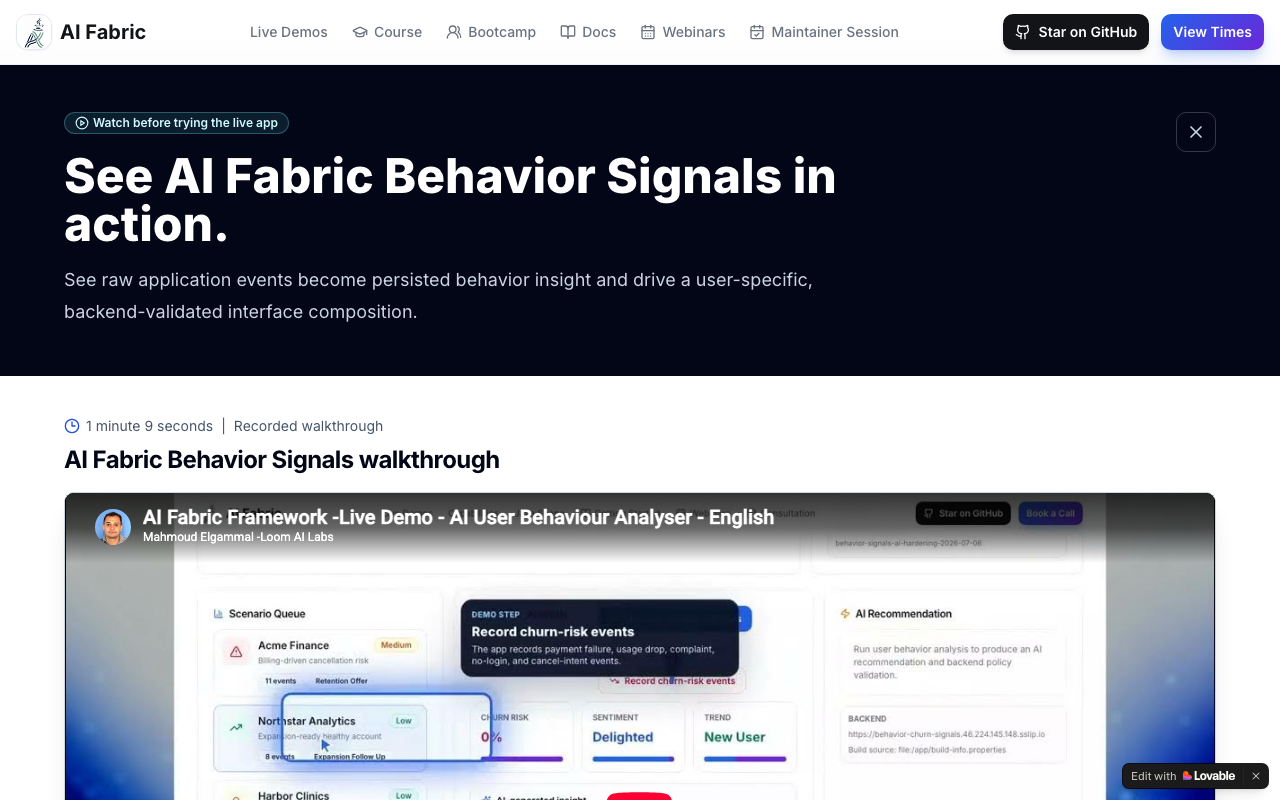
Behavior Signals

A product team inspects synthetic engagement signals, generated explanations and bounded follow-up suggestions.

  • Structured output
  • Signals
  • Explanations
  • Actions

Signal values remain visible alongside generated explanations.

Compatibility and release status

Current public integration surface

  • Spring Boot applications
  • Spring AI foundation
  • Maven dependency management
  • Provider and vector-store extension points
Current release v0.4.0

Early release · Apache 2.0

View release history

Contribute

Help shape AI Fabric Framework.

Inspect the implementation, open a focused issue or bring a reproducible application boundary that the current contracts do not handle well.