Abstract
Research question
Which request context must be resolved by application code before AI orchestration begins?
Context
Natural language can mention a tenant, domain or entity type, but mention is not authority. Retrieval quality and isolation both degrade when inferred labels overwrite valid application context.
Proposed approach
- Resolve identity and tenant membership in the host application.
- Promote trusted vector-space and entity hints into orchestration context.
- Allow model extraction to clarify user intent without replacing trusted scope.
Implementation
- Request-context propagation through AI Fabric orchestration
- Vector-space resolution that honors valid application hints
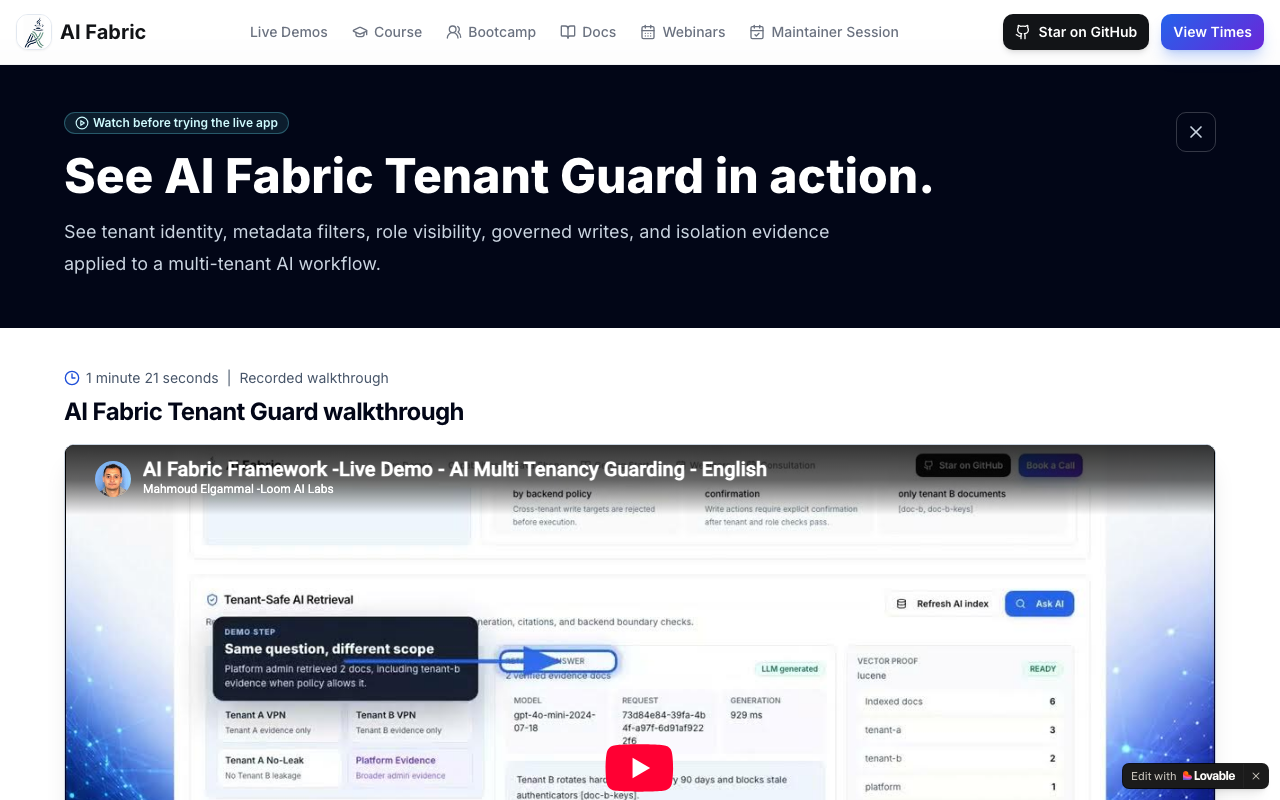
- A multi-tenant knowledge portal demonstrating filtered retrieval
Observations
- 01
Trusted context and model-extracted intent serve different purposes and should remain distinguishable.
- 02
A valid application hint can prevent an unrelated extracted label from sending retrieval to an empty space.
Limitations
This work reports an implementation-linked investigation. It is not a
peer-reviewed paper, certification or customer case study.
- The demo tenant selector is not an authentication provider.
- The study does not claim formal tenant-isolation certification.
Reproduce or inspect
Revision note and next questions
Last revised 2026-07-25 against AI Fabric 0.4.0 and the linked public artifacts.
- How should context provenance be represented across remote connectors?
- Which context fields should be immutable after orchestration starts?